
Permission
To assign a user related requirement, you must have the user role of Administrator.
Assigning Certificate Requirements
User requirements can be assigned in three different ways.
They can be attached to a specific User group, to a Specific program and/or lesson, or directly to an Individual user.
Choosing the right method depends on how broadly the requirement should apply and how you want it managed within your operation.
Assignment on User groups
To start with assignments, go to Administration, open the drop down menu, select Requirements, and choose Assign.
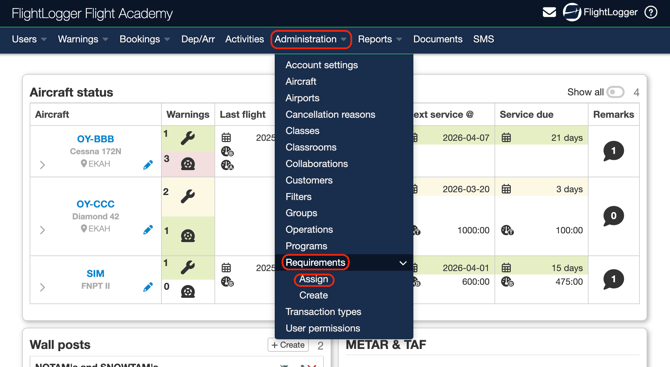
This will open the assignment page.
At the top of the page, you will see the available resources and user groups.
*Note: Assigning Resource related requirements are covered here. xxxxx
To assign a user requirement, the first step is to choose the relevant user group. You can select from administrator, crew, flight instructor, ground instructor, renter, staff, or student.
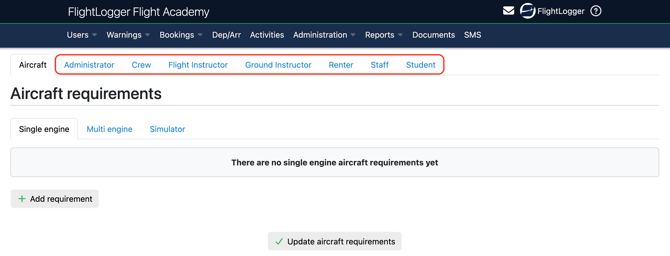
*Note: If the Flight and Duty time limitation module is enabled on your account, those requirement types will also appear here. Assigning Flight and Duty time limitation related requirements are covered here. xxxxx
From the list, click Add requirement.
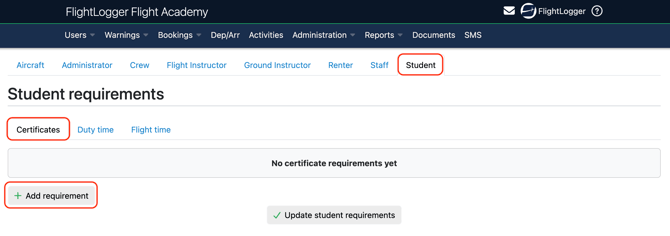
Then select the relevant requirement from your previously created master list
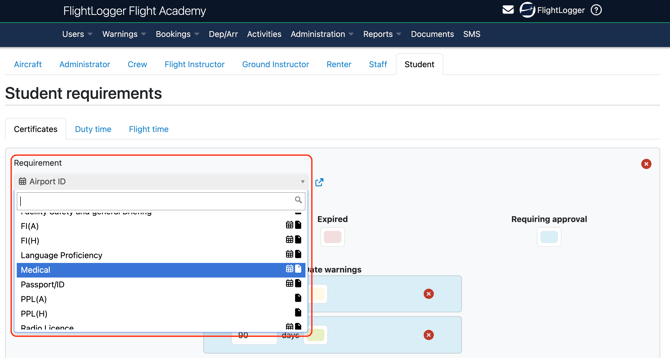
Choose the requirement from the list, and then select Update requirements.
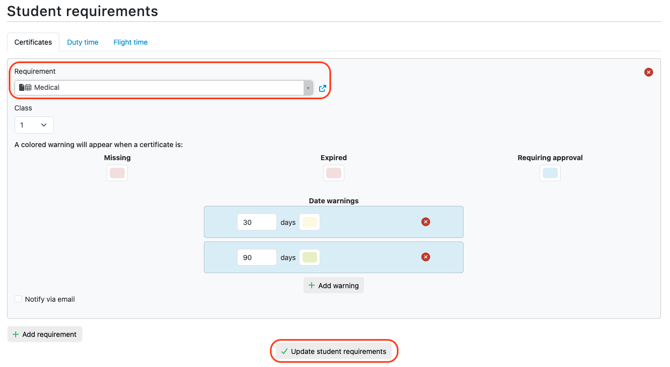
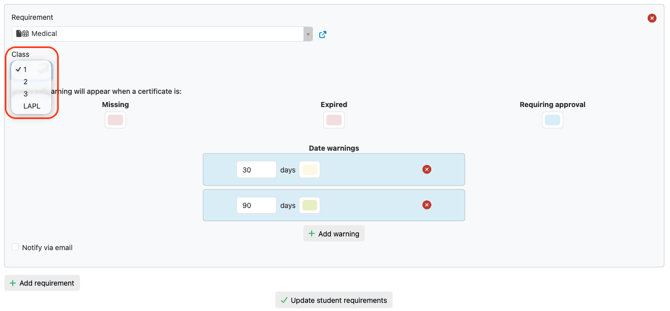
Please note that when assigning a medical requirement, this is where you must select the relevant medical class, such as Class 1, Class 2, Class 3, or LAPL.
The selected class defines which type of medical the user must upload. This setting cannot be changed elsewhere. Once users have been assigned to this requirement, the medical class can no longer be edited.
You can only change the selected class if no users are currently attached to the requirement.
´
Once assigned to a user group, the requirement will automatically apply to all users within that group.
For example, if a medical requirement is assigned to the Student group, every new student registered in FlightLogger will automatically receive that requirement and be prompted to upload a valid medical.
Assigning requirements to a user group is recommended for general requirements that apply to everyone in that role, such as a medical certificate, airport ID, passport, visa, or driving licence etc.
Assignment on Programs and Lessons
To assign a certificate requirement to a specific program, lesson, sortie, or mission, go to Administration and select Programs.
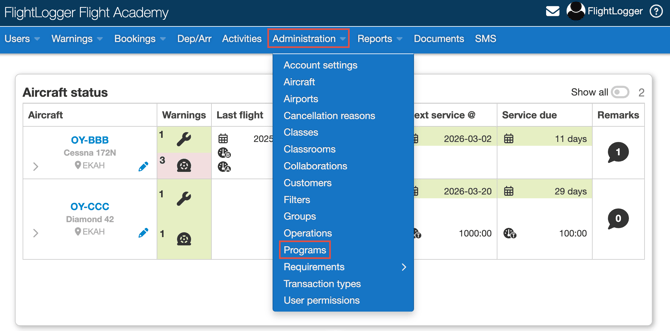
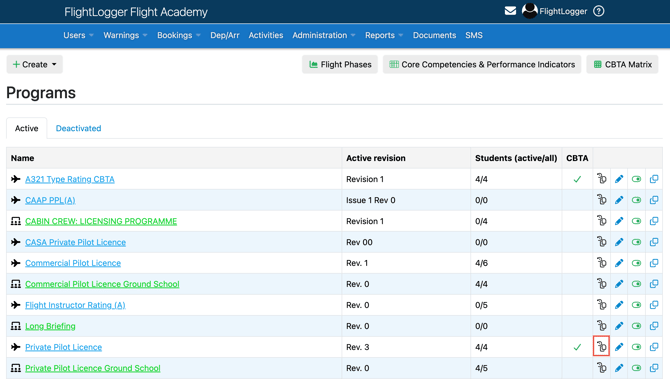
In the program overview, you will see a symbol in the fourth column from the right that represents certificate and flight duty time requirements. Selecting the symbol opens the requirements page for that specific program.
On the left side, you will see the program and its revisions.
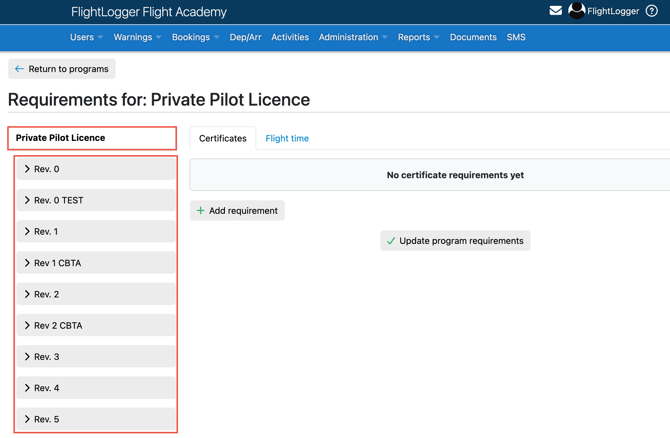
If no specific revision is selected, the requirement will, by default, apply to the entire program, including all underlying revisions.
To add a requirement at program level, simply select the Add requirement option under the certificates section.
Once assigned, any student enrolled in the program will automatically receive the requirement as soon as they become active on it. The requirement applies regardless of program revision.
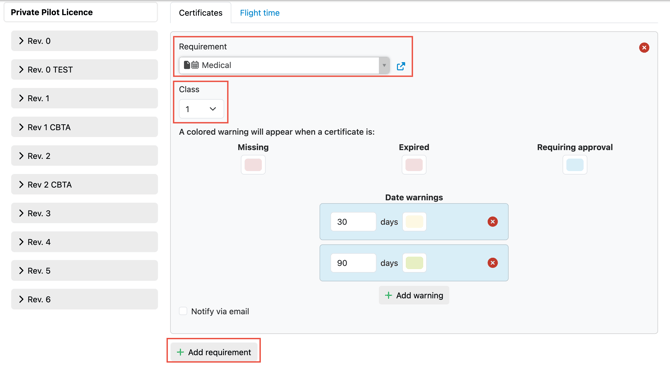
*Note: As shown in the image, if the flight time limitation module is enabled on your account, an additional tab called Flight time will also be available, allowing you to assign flight time limitations at program level. See this article on how to assign the Flight Time requirements.
You can also assign a requirement to a specific lesson, sortie, or mission. This is done on the specific revision.
For example, if a student is scheduled to start flying solo in a specific lessons, you may require them to upload a radio certificate before continuing. In that case, you would attach the requirement to the lesson prior to the solo flight. When that lesson is completed and submitted, the requirement will immediately become visible to the user.
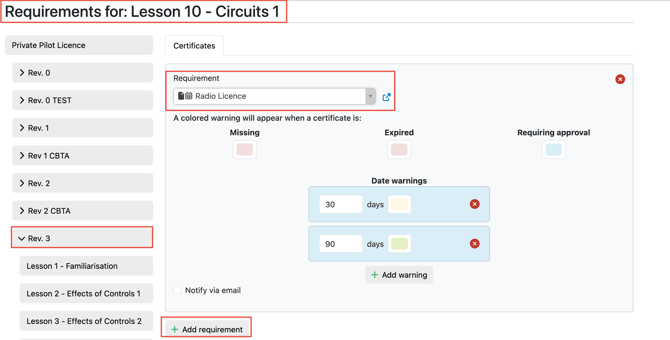
Requirements assigned at program or lesson level are typically program specific. For example, a student enrolled in a CPL program may be required to upload a valid PPL certificate.
These types of requirements are more specific and should be used where they apply only within a particular training context, rather than at general user group level.
Assignment on Individual Users
The third option is to assign a requirement directly to an individual user.
Go to Users.
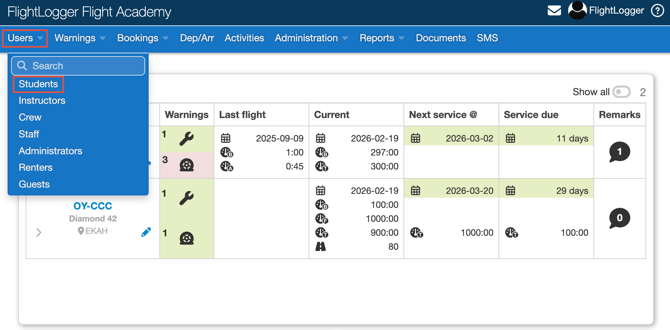
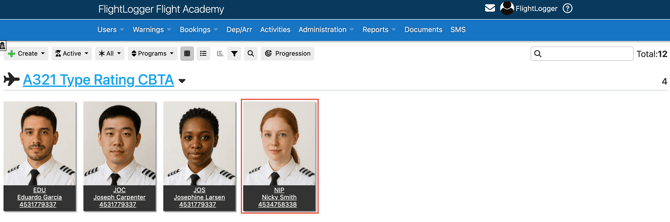
Select the relevant user group, for example Students. Select the specific user.
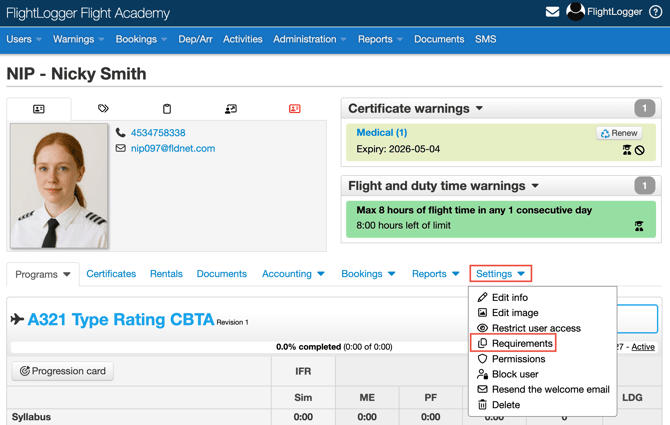
Under Settings, choose Requirements.
Add the requirement to that user. The requirement will apply only to this individual. Other users in the same group will not be affected.
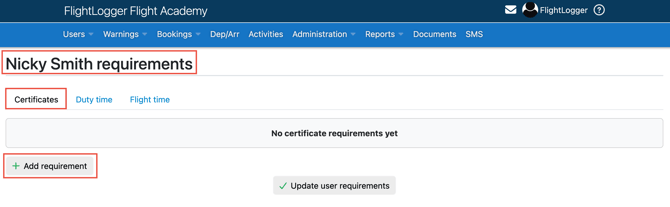
*Note: If the Flight and Duty time limitation module is enabled, you will also see options to assign flight time and duty time requirements here. If the module is not activated, these options will not be visible.
Individual assignments are typically used when a requirement applies only to one person. For example, if a general medical requirement applies to all users, but one specific user has a special medical condition approved by an AME, you may assign a different or additional requirement only to that user.
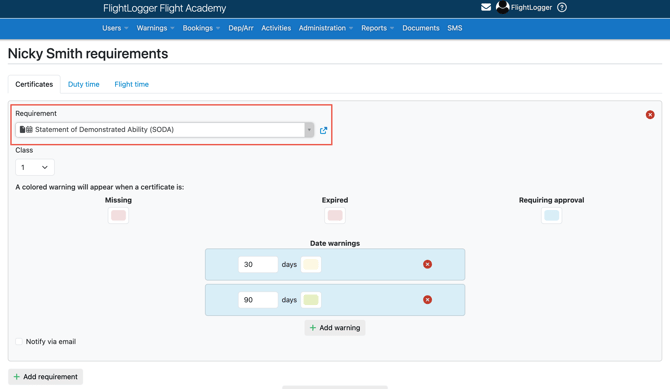
Editing options
As explained in the sections about creating requirements, you can configure warning times, warning colors, and notifications.
These same editing options are available when assigning requirements.
The system includes default warning colors for missing requirements, expired requirements, and requirements awaiting approval. These colors provide a clear visual indication of the current status.
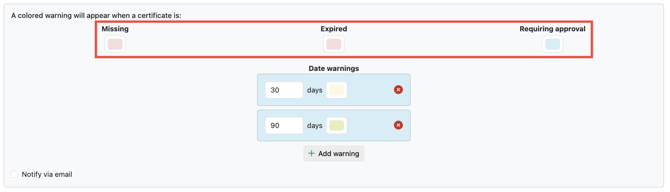
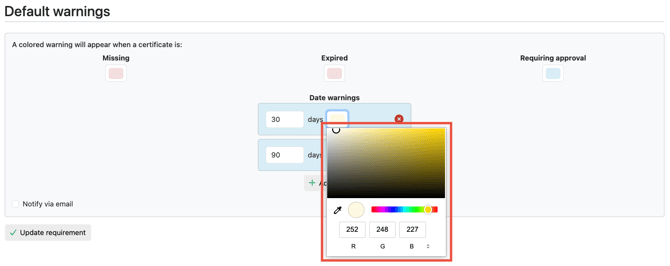
Administrators can change these colors by clicking on the colour box, which opens the color configuration window. Here, you can define your own custom colors as needed.
The selected colors will be reflected on the user profile page and on the front page, giving users immediate visual feedback on their own requirements..
Under the Default warnings, all warning time intervals can also be edited to match your operational needs. These will define how long before expiry a notification should be triggered.
You can also change the warning colors, as described earlier.
If you want to remove a default warning, you can delete it using the delete option.
You may also add additional warnings, for example a third or fourth time based reminder, depending on how early you want to be notified.
For user requirements, you can enable email alerts. When this is activated, the user will receive automatic emails from FlightLogger at the defined intervals, for example 90 days before expiry, 30 days before expiry, and again on the expiry date itself. These notifications follow the warning intervals you configure.
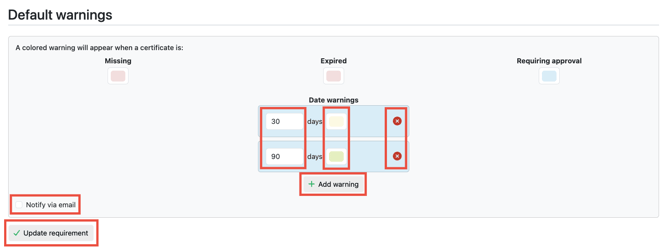
When you have finished configuring the requirement, remember to select Update requirement to save it.
Need help?
If you have questions about setup, permissions, or best practices, contact us at support@flightlogger.net